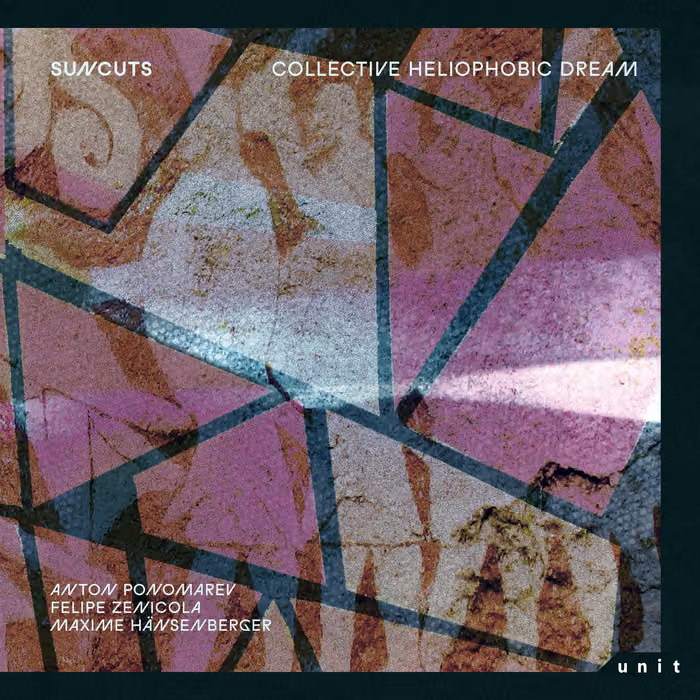
Collective Heliophobic Dream by Free Jazz trio Suncuts is a rare case where metaphor is not used for its own sake but becomes a working compositional tool. The sun here is not a poetic image but a state: a source of energy that both nourishes and burns, attracts and repels. It is within this dual tension that the album’s sonic architecture unfolds.
The trio came together almost by accident, yet sounds as if it has existed for a couple of decades. After leaving Moscow, saxophonist Anton Ponomarev intended to continue developing his project Teufelskeller, but when the bassist and drummer were unable to travel to the Xciting Festival in Stuttgart in 2023, where the group had been invited to perform, Ponomarev asked Brazilian bassist Felipe Zenicola and Swiss drummer Maxime Hänsenberger to join him on stage. That is how Suncuts began.
The musicians operate in a field where Jazz ceases to be a genre and becomes a method — flexible, porous, open to noise and electronics, and the extravagant gestures of both. Their debut studio session, captured in the five tracks of Collective Heliophobic Dream, does not so much document improvisation as shape it into a form of collective statement.
There is no familiar free jazz dramaturgy of “build-up — climax — release” here. Instead, there is a pulsating force in which sound behaves like substance: it condenses, disperses, and reassembles into dense, almost corporeal structures. Ponomarev’s saxophone bursts are not solos in the traditional sense but rather energy discharges immediately absorbed by the rhythm section. Zenicola’s bass functions as gravity, holding all fragments within a singular orbit and preventing music from disintegrating. Meanwhile, Hänsenberger’s percussion, with its metallic sheen, lends the entire construction an industrial sharpness, as if the surface of the sound periodically cracks.
Nevertheless, for all its aggression the record does not reduce itself to noise extremity. Within its sonic turbulence, zones of transparency constantly emerge — brief, almost fragile pauses where one can hear the musicians literally listening to space, probing the air. These moments do not relieve the tension; on the contrary, they intensify it, making each subsequent sonic attack feel like a deliberate gesture.
Ponomarev describes what unfolds on Collective Heliophobic Dream as a “sonic ritual,” and this is perhaps the most precise description. Yet the ritualistic quality here lies not in repetition but in concentration: each sound seems to undergo a test of necessity. Even chaos, in Suncuts’ hands, feels thought over.
The result is a paradoxical experience: the album simultaneously bears down on the listener physically, overwhelms, and yet internally consolidates you. As if you were placed inside a source of light — say, a thermonuclear reactor called the Sun — and asked not to close your eyes.
(Note of the editor: A few months ago we also we reviewed another record Anton was involved in: Witness Wounds’ self-titled record)