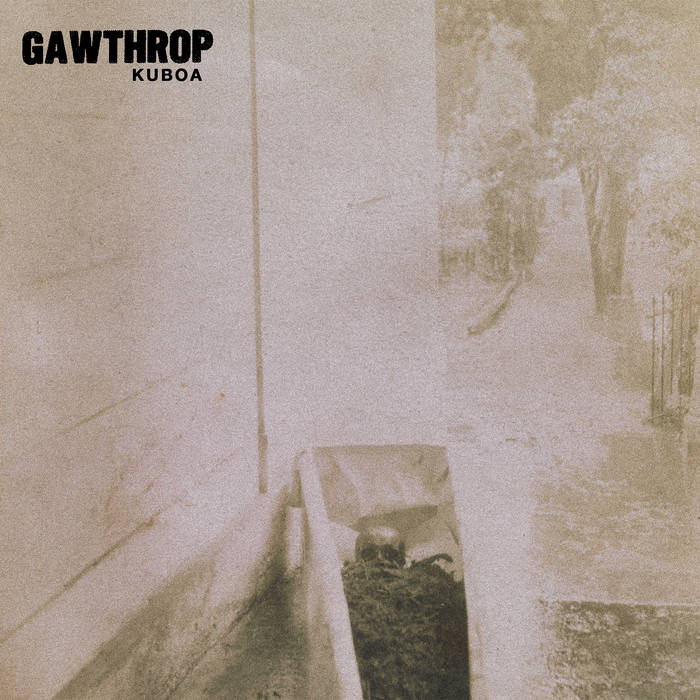
Ever since their excellent 2019 self-titled demo, Seoul’s Gawthrop have been dragging Sludge Metal back to its nihilistic, confrontational roots. Kuboa is the band’s debut LP, and aims to bring a tighter focus to this mission. Citing artists like Corrupted, Noothgrush, Coffins, and Meth Drinker for this LP in particular, the band are clearly aiming to make punishingly heavy music without much adornment. It comes in at a tight 36 minutes – there’s no intro track, there’s no interludes, there’s just Sludge.
Across Kuboa, Gawthrop build and maintain a bulldozer-like momentum. This is slow music, sure, but for Sludge Metal it is by no means the slowest. Riffs are rarely drawn out into totally glacial abstraction – instead the band is most often hammering away through tracks with methodical, propulsive power-chord shifts.
The meat-and-potatoes sound of Gawthrop is a rumbling, distorted bass, sharply-fuzzed guitars and clanking, metallic drums. Vocalist Sunggun’s rasping, barked screams are unbelievably aggressive and distorted, going between three main modes depending on what the moment calls for: a demonic howl that reminds me of Primitive Man’s Ethan McCarthy, some desperate insane shouts, and some more traditional death-growls.
Minhwi’s bass tone is room-shakingly thick, and the occasional full-fretboard slides that cue in new riffs sound like collapsing buildings – when a band is so much about the riff as Gawthrop are, a bass tone like this does a lot to elevate what would otherwise be a primitively aggressive stomp, especially given how locked in Minhwi is with Owen’s drumming. His playing isn’t as cavernously recorded as on previous releases, but it is still impactful, with razor-sharp cymbals and shotgun-blast snares.
The guitars of Hyunwoong and Sunggun are similarly massive. Compared to Gawthrop’s earlier releases there’s a degree of clarity to them, too, despite the downtuning and the gargantuan amount of gain. They’re sharper, more scooped than any Sludge or doom that draws on old-school Sabbath tones – instead they orbit much closer to the early feedback-soaked hardcore tones that inspired the originators of Sludge. The band’s description of it as “amplifier torture” seems more appropriate than the doom alternative of amplifier worship.
Hit play and the opening minute of the album hints at perhaps a more occult, stoner metal record than actually arrives – a sample crackles alongside some crackling organ straight out of a Hammer Horror film. But any sense of weed-smoke and incense is immediately destroyed as a flood of molasses-thick Sludge comes crashing in with the first true riff of the album.
The first couple of tracks are where the band’s focus is most keenly on a more monolithic Sludge march, with bass and guitars focusing on blunt, punishing sledgehammer-heavy riffs. Things don’t remain solely in the sewers – occasionally whole riffs will shift upwards in almost bluesy progressions, but it’s not long before a thunderous bass slide brings things crashing back to the tar-thick lower registers.
And just as you’re ready for a change of pace from the more monorhythmic approach, Gawthrop delivers it, as the third track “Granfalloon” falls apart like a poorly-built molasses storage tank, laying the ground destructively for the more expansive and melodic intro to the fourth, “Nutria”. By the end of which, some delay-soaked lead guitar has entered, intermingled with a vocal sample so heavily distorted it’s hard to extricate from the rest of the mix.
From here the second half of the album builds in complexity, never to the point of undermining its impact, until we reach the last original on the album – “Jimmy”. It’s one of those tracks that, when it arrives, feels like the rest of the album was always building up to – it’s the “most”” song on the record – the most heavy, the most chaotic, the most abrasive. For my money, the best track on Kuboa and the best example of this group’s central premise.
And to close, like a final kiss on the cheek after a thorough beating with a tire iron, a little cover of “In Heaven” from Eraserhead. Its inclusion brings me a lot of joy. Not just because I love Eraserhead, or because it’s kind of inherently funny to cover a track like this in this way. It brings me joy for two reasons. Firstly, if you were to transmute Sludge Metal to film, Eraserhead is a pretty damn good fit, with its droning industrial noise and disorientingly extreme domestic discomfort.
Secondly, Gawthrop end their cover with a single major chord played on a cheesy keyboard patch, one so saccharine and uplifting as to be totally alien to all other musical content on the record. This is a great and hilarious thing to do, like cutting in an episode of My Little Pony in place of the credits of Hellraiser. I’d say it makes the rest of the record heavier by comparison, but it doesn’t last anywhere near long enough to do that – instead it’s just a fun and ear-catching way to indicate that an otherwise gruelling 36 minutes is up.
In all Kuboa is a tightening of the ideas Gawthrop began honing on their demo and their earlier EPs. Some moments had me missing the more cavernous, raw production of those previous releases – particularly with regards to the drums – and while I do think it’s a tighter sound, there’s perhaps a bit of edge lost with the cleanliness of things. But from a perspective of reminding everyone about the brutal, punishing potential of Sludge Metal as a whole, the record is still absolutely a success.