How Pamplemousse’s Antisocial Behavior Birthed Brilliant Artistic Innovation in Porcelain
In his first-ever interview with an English-speaking music journalist, Pamplemousse’s Nico Magi speaks transparently (with a capital T) about how his Noise Rock band’s fresh sound is the result of his fear of not being able to play music “properly,” the enormous pressure he puts on himself and those with whom he collaborates, and his belief that whatever he creates is never good enough. Even more than providing insights into his French band’s recently released album Porcelain, Magi provides us with a clear assessment of the life of a true artist who creates some of the most innovative, unconventional and compelling music put on record anywhere in the world.
Hey, Nicolas. How was your day? Or, better yet, what’s a typical day in the life of Pamplemousse?
Usually, we go to rehearsal in the morning. We go to practice with (our drummer) Sarah (Lenormand) in the morning, and after I come back home, sometimes I do a little bit of jogging, and I listen to new music. That’s about what I do every day. I’m not the kind of guy who goes out at night. I usually stay at home with my family.
Where do you discover new music?
Through friends or the internet. Instagram. When I’m watching a band that I like and they talk about another band, I go to listen to that band. And sometimes Spotify gives me something to listen [to].
Are you pretty pro-technology or do you tend to resist it, at least initially?
I’m not against technology, but I don’t use it too much. I think it’s helpful to have technology right for a band like Pamplemousse.
Pamplemousse translates to “grapefruit,” right?
Yes, I believe so.
I love it. It reflects how unusual your band is, in a way. And it took about three minutes listening to your music for me to realize that you’re doing something very different and special. Just when I think I’m never going to hear anything I haven’t heard before, along comes a band like yours.
Oh, thank you very much.
So, Noise Rock is back in full force. I don’t know if I would really call you guys “Noise Rock” per se, but there’s certainly a relationship there. What inspired you to make music and what drove you emotionally to make art?
When I was very young, under 10 years old, I realized that I was the kind of guy that was very lonely. I always have problems connecting with other people. I always felt like I was an odd person, you know? And as a young boy, it was a little bit complicated for me because I didn’t know how to explain this.
When I was about 14 years old, we moved from Réunion Island to France. That was a really big change for my family and I. And that wasn’t a good time. Before going to France, I was playing a little bit of guitar. And, when I arrived in France, I said, “I have a few friends. Let’s make a band.”
At the time, I thought making music was just for fun. But now that I’m 50, I think I wanted to (push) something (out) of me, some anger. So I started to play in a band. I’ve never been such a good musician, and I don’t think of myself as a musician. I just play guitar. I don’t know what note [I’m playing]. When I found music, [I realized it] helped me to communicate with people, I think. [Since then,] it’s always been like this.
I don’t have a very active social life, you understand. I don’t go out at night. I don’t drink. I don’t like to go to parties with lots of people I don’t know. So when I make music and when I go onstage, it’s a time where I can communicate with people and it makes me feel better in my life.
If you don’t consider yourself an extremely social person, why did you want to work with other people on music? And then why did you want to play in public spaces?
That’s … I don’t know if you know the name “paradox” in English?
Yeah.
That’s it. That’s the paradox. I don’t know why. I think I want to be onstage because I think it’s the only place where it’s my turn to talk. Everybody has to shut the fuck up, and I can talk because it’s my little time where I can be really myself.
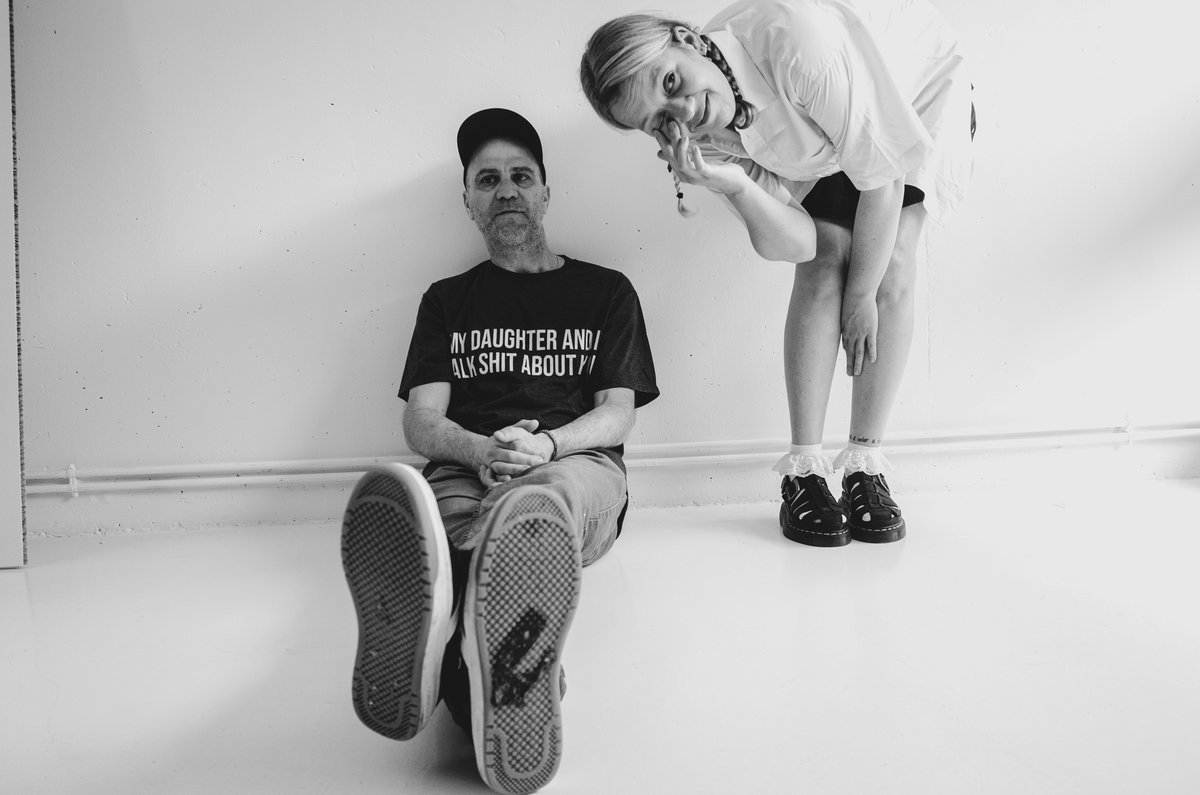
When we started Pamplemousse, we were a trio. I always have problems with people. Now we are only a two-person band. It’s me and my girlfriend. So it’s a family business.
I have so many problems with other musicians. Guys didn’t want to practice enough. So, one day I said to my girlfriend, who was playing bass at the time, “Enough. I don’t want any more of that drummer. So now you play drums and we can go on with the band or we stop now because [I’ve had] enough. And she [had] never played drums before.”
We worked very hard for one year, and we made [Pamplemousse’s] second album as a duo. When we go on tour, [it’s] my girlfriend, me and our daughter. She’s 14 years old and takes care of the merchandising.
Do you ever get into family arguments onstage?
No, never onstage. Onstage it’s always good. Sometimes before going on stage, it can be [rough].
I don’t want to get into areas that make you feel uncomfortable, but are you able to expand on why you have challenges getting along with other musicians? Do you know what the root is of your social issues with people? Do you just simply like to be by yourself? Do you get irritated easily?
Firstly, I think I might be very sensitive. I don’t know. This could sometimes create problems (..) I think the biggest problem that I have as a person is I have a very low self-esteem. I don’t have very much confidence in myself, you know?
It’s complicated sometimes to be around people. I’m always afraid to not be as good as I want. It’s complicated to be around people, and when you are around people, they’re talking about things that don’t interest me at all. I don’t know what to say [to them]. Why am I here? Why am I spending time with you? I can only spend so much time with people before I have to say, like, “OK, I gotta go now because otherwise I’m going to get upset.”
But do you feel that’s the reason your music is so good?
It’s very nice for you to say that our music is very good. I work very hard for the music, and I want to be very proud of myself. I’m very demanding of myself.
You’re hard on yourself. You have high standards.
Yes. Sometimes we work very hard. Sometimes we go to rehearsal every day, every morning. Perhaps because I’m this kind of guy, I will always want to be better. So perhaps our music sounds good [and] different from other bands because we have no codes. Like I told you, I’m not a musician. So I try to make sounds with my guitar, but I have no code. I didn’t learn [how to play] music. I’ve done everything by myself.
Sarah [had] never been behind the drums before. And I said, “OK, here are the sticks. This is the snare. This is the kick drum. So now let’s go. OK. And she has done everything with her feelings.” She didn’t go to a drum school or something like that. Therefore, I think it makes the band sound not like all the other bands.
Sometimes people call somebody who’s very good at playing music in a traditional sense “gifted,” but personally, I feel like there’s also a way to talk about somebody being gifted as a musician if they don’t know how to play music traditionally? If they’re able to get something out of themselves and put it into a music medium, then that translation, that ability to communicate, that’s a gift.
Do you think you demand a lot from other people because you’re so hard on yourself?
If these people are in my band, yes. I have a few friends, not many, and they are very different. I know some people that I love, that are very cool with life, who don’t have a job and everything is OK. And I know other people that are very hard on themselves too. And I don’t think I need to be surrounded by people who are like me. I just like people that are kind to me and people that I love. I don’t care if they are like me or not.
When you changed the configuration of the band to just you and your wife, were you tempted to rename it?
We thought about it, but we really like this name. If the music is good, then you can call yourself whatever you want.
What makes a great song, in your opinion?
It’s hard to verbalize. And it’s a question of feeling. Sometimes you have a song that is very complicated with lots of parts. And there’s something strange in your body when you’re playing the song. You’re not OK with it. And sometimes you have a song which has only one guitar riff. And when you play it, it is OK. Like the first song on (Porcelain), “More Beautiful Than Madonna”. This song came out of nowhere. We worked so hard for months and didn’t have any idea to make a song. And one day, this idea came out, I don’t know from where. We played it for about one hour in the rehearsal room. And we said, “OK, that’s a song. Let’s not go further. Let’s leave it like this.”
It’s about feeling. When the song is well-balanced, and when you’re OK, and when you sing it, sometimes you have chills. That’s a good song. It’s complicated to put words on this.
But it’s also when you’re working with just one other musician, as opposed to two other musicians or more. It’s probably easier to decide on your own that a song works and that it doesn’t need adjustments, right? Because if you have other people involved, there’s a lot of second guessing?
Yes, it’s definitely easier when you’re only two in the band. And we are a couple in life, so we know each other very well. Yeah. And there isn’t a third or fourth person to say, “Oh, we should do this, we should do that.” It’s easier to feel if the song is good or not. But it’s more complicated to make a song because you don’t have any interactions between instruments. You have only the drums that don’t make notes, and me on guitar and bass at the same time. So when I play something, there is not another instrument that’s connecting with the guitar to create something else. And that’s more difficult.
Do you feel like your songs, at least some of them, might be a little more limited than you’d like them to be, because of that?
When the song is finished, I don’t have this feeling. But when I’m writing the song, I have to work harder, I think, because I have to … [as] you say in English, compensate?
Yeah.
I have to compensate that there is no other instrument. So I have to make my guitar sound bigger or like there is another instrument.
We played lots of shows where sometimes people, when we go off the stage, come to see us and say, “This is something amazing when you play. Sometimes we heard violin or synthesizers in the back.” [It’s] because of the way I play the guitar to compensate. So it’s cool, but to write the song, it’s a little bit more difficult. That’s why we work so hard. And that’s why, again, we sound like this.
But the way you’re playing really seems to allow for inventiveness and a fresh approach to what could be a more standard or traditional sound, right?
Yeah, I think.
Do you ever surprise yourself with what you’re able to do with your guitar?
Yes, it happens sometimes. I’m not surprised by my technical skills, because I don’t have any, but sometimes when I hear what we’ve done, or what I’ve created with my guitar, when I hear it on the record or something, I’m very happy with it.
Are those the songs that you tend to play more often live?
Yes. When you make a record, it’s very rare that you’re in love with all the songs. You like all the songs, but you like some songs more than others. I also like when [the performer onstage seems to have] this need to communicate with the world and they have something that they want to get out, [rather than try to sell their latest album].
I think that’s why I did love very much the scene from the ’90s, because I felt like this band that I love looked like me, you know? They didn’t have to, to, to have to be or to dress something special to go on stage. Like Girls Against Boys and Fugazi. My preferred band in the world is Fugazi. I love the way this guy makes music and looks so natural. When I discovered this scene, I felt like, “OK, I’m not alone. I can dress myself like every day and go onstage. I don’t have to put a hat on my head.” I think this was really important for me, because I go onstage because it’s a need. It’s not to show who I am. I just need to communicate this time. And when it’s over, I go back home. You don’t hear about me.
The thing is, as you get older, you don’t want to sound like an old man and be like, “Oh, you used to be better back then.” But I gotta say, I love the sound that bands had in the ‘90s. Now, for me, it’s too much bass, it’s much louder, especially in France. I feel like every band has the same sound. Back in the ‘90s, each band had its own sound. The Jesus Lizard. Steve Albini. Girls Against Boys. Unwound. And the bands in the ‘90s used to record on tape. There were edits, but not like now, where you can edit everything you want [to ‘perfection’] with the computer. Sometimes the music [sounds] less alive. I miss that time.
Before our conversation concludes, can you tell me what you had in mind going into the making of Porcelain and whether you feel like you achieved your goal with the record?
We didn’t have any goal at all. We wrote some songs. Life has changed between Porcelain and (2023’s Think of It). We moved from Réunion Island to France.
Every time we make a record, you go to the studio, you record it, you mix it, and then you sit down at home, you press play and you say, “OK, it sounds like this now.”
We didn’t expect anything. As we were doing it, we didn’t know [what we were doing either]. And now that the record is done, we’re pretty proud of it. But honestly, we didn’t know where we were going. It doesn’t sound like the last album. I think it’s a little bit more brutal, a little bit wild, a little bit more live. I don’t know.
Did you know that, being a two-person band as opposed to a three-person band, you would have to get more inventive or explore different areas that you hadn’t before?
We always should explore other ways to make music. I’m always thinking about this. But the problem is when you make a song, you don’t think about it. It’s not a conscious thing. Sometimes I say to myself, “We should try to have a synthesizer in the band to have another sound.” But at the end, when we go to the rehearsal room, we don’t do this. I think we have a certain kind of way to do the music, and it’s always the same. But the songs are not the same. It’s complicated to explain.
I feel like it’s impossible for us to say, “OK, with the next record, we’re going to play slowly. We’re going to be more like this, more like that.” Sometimes you don’t know why a band’s gonna have an influence on you. And when you go back to a rehearsal, you have ideas that are more connected with this band that you have listened to.
Did it take you longer than usual to make this record, or did it come easier?
It didn’t take longer, but it was harder, because we had something like five songs. And then, for a period of I think four or five or six months, nothing came out. So we started to have doubts about the songs we’d done before. We had to compose another three or four songs to finish the record.
When I make music, I ask myself a lot of questions, and sometimes it can be a problem — especially for my girlfriend, because she likes to make things very fast. She doesn’t want to think about it again and again. And this period where we didn’t have any ideas to make songs was very complicated for me, because I had lots of doubt.
I thought our band was completely crap. I didn’t know what to do. And you have to move on, try to be positive. So it was a little bit complicated, this one. Now I’m happy it’s over. I’m very proud that we had the strength and found the energy to make this record, because it’s always complicated to make a second record. I’m very proud that we made it. And I’m very proud of my girlfriend too, because she’s got something with the drums that is unique. She’s special.