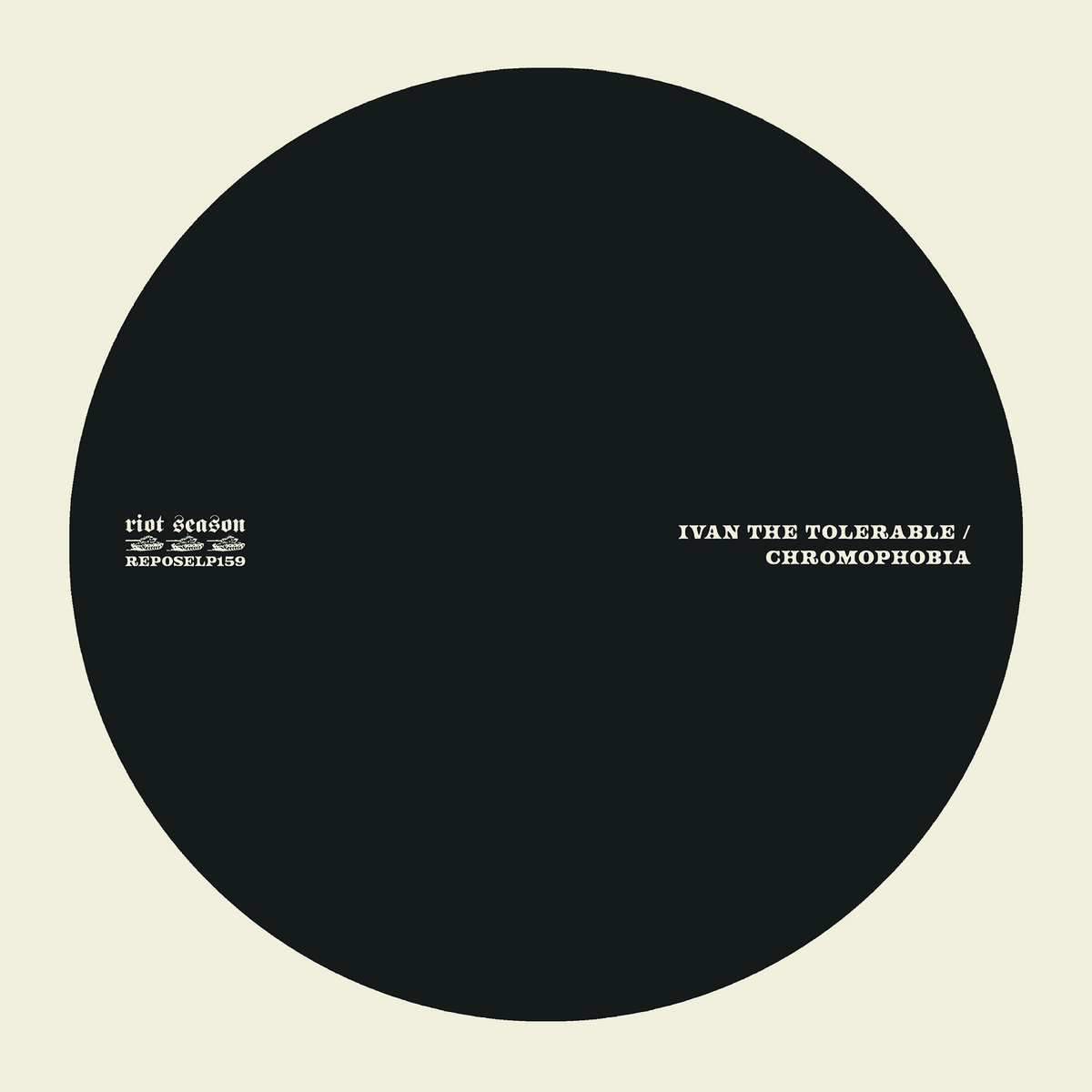
Rorschach minimalism: Black circle on white background. What do you see? A void? A hole torn into life? Or the bright light of a new dawn only momentarily obscured by a rock? The ambiguous geometry on the album cover complements the musical question of what is actually more important: Is it what we can hear? Or is it what is missing?
Northern English multi-instrumentalist Oli Heffernan surely is one of those artists who can fill completists with severe anxiety. Under the moniker Ivan The Tolerable (or variations like Ivän The Tølerable Trio, Ivan & Friends, Ivan The Tolerable Quintet etc.), aided by new and returning collaborators or completely on his own, released by a rotating array of independent labels including Riot Season, Stolen Body Records, Up In Her Room, Library Of The Occult, Echodelick and Ack! Ack! Ack! Records, he seemingly puts out new music almost every month. And while you’re surely allowed to still call yourself a fan, even if you cannot keep up even with half of his prolific release schedule, his material, which ranges from different shades of Psychedelic Rock, Jazz, Fusion, Post-Rock and Ambient to Experimental Music always maintains a high quality standard.
Naturally, every listener will find their own favorites in the Tolerable catalogue. I’m especially drawn to the works drowned in Spiritual Jazz like the 2024 Trio epic Infinite Peace or the magically meditative sister Quintet albums Vertigo and Water Music, both also from that year. The playful New Age-spirited Fusion of Black Water/Brown Earth (2023) introduced me to Ivan The Tolerable and has a place in my heart close to them as well as the continuous space Ambient flow of his solo performance on Live in London, which yes, is yet another album released in 2024.
The double album at hand now however is very likely to be universally recognized as a momentous point in Heffernan’s output, not only due to its sound, but also because of the history which made it what it is – and what it is not.
It began as series of electronics-heavy solo recording sessions, engineered by longtime collaborator Nigel Crooks in 2018. But as it inevitably will happen from time to time when you have many pots on the stove, it got put on hiatus for various reasons - until it was too late to finish it, because Crooks, who at that point was quite annoyed they didn’t get it done, tragically passed away in 2023. Heffernan wanted to complete the work nonetheless, but couldn’t do it on his own, so he brought in Hugh Major (ex-Benefits), who massively reconstructed the recordings, added further synths, loops and drum machines, ultimately transforming the album into something wholly new.
The result is an 80 minutes long double album made out of fourteen instrumental tracks with a sound aesthetic clearly on the Electronic Kraut side of Ivan The Tolerable’s spectrum. There’s no Jazz on Chromophobia, yet ,especially given its size and sincere, profound background, it feels like a foreign-language counterpart to Infinite Peace to me.
According to the artist and the label Riot Season “it’s a very different beast from where it started” and “it stands as both a reinvention and a tribute; a document of persistence, creative overhaul, and the enduring impact of a lost collaborator.”
Since we’ll probably never know how it sounded in the beginning, I can only assume what survived the process and what was changed drastically. And I think an important clue to that is the title.
‘Chromophobia’ is the fear of colour, both as a medicial condition, but also figuratively. Like most of Heffernan’s music, there seems to be a very playful Psychedelic core to everything and track titles such as “Wild Blue Yonder”, “Orange Crayola” or “African Violet” even include colours. I can imagine though that Heffernan might have struggled with the balance between light and darkness, not wanting anything on the album to feel too sweet, sparkly or carefree, but also not alienating the listener by being too monochrome or even depressive. And exactly the very careful and fruitful fine tuning of this balance is what makes Chromophobia so special.
All tracks are centered around simple ideas. Mostly it’s just one synth loop, one clear-cut minimal bass line or guitar riff, accentuated with both electronic and acoustic Ambient ornaments and straight-forward or contrastingly elaborate drum beats. And while all the added layers create surprisingly rich textures and potentially great hooks, there’s always a deliberate impression of something missing, of the resisted temptation to turn each piece into a much bigger song.
Instead Ivan The Tolerable makes each piece feel like a sketch – a very detailed sketch, but still with the lingering notion of gaps yet to be filled. He obviously keeps a certain distance to his own tracks. Following the kraftwerkian ethos of ambivalence, which presented their observance and vision of technological progress as it was with little judgement, Chromophobia also comes without a preconceived dictation of sentiments. Even during its most upbeat ideas like “Inchworm”or its darkest moments like “Black Olive”, which opens the incredibly strong second half of the album - and could also be depicted on the cover artwork – the music never explicitly tells you to feel happy or sad.
No matter if the sounds leans towards Düsseldorf or Berlin 1970’s Electronic, 80’s Synthwave or White Hills Walks For Motorists-style Psychedelic Rock I somehow feel strong emotions during the whole duration of the album, but can seldom name them, because they either pass by hazily in the distance or hypnotically carry me in floating waters, in which everything is inextricably mixed with each other.
So back to the Rorschach test: Do I see the void or do I see the light?
I’d rather tend to the latter, because ultimately Chromophobia provides a very inspiring and stimulating experience that always leaves me more fulfilled than before. It will certainly prove itself as one of the most important Psychedelic records of the still young year – and in a strong and diverse discography it stands out as a work which undoubtly deserves to be praised as a masterpiece. Nigel Crooks would indeed be proud!