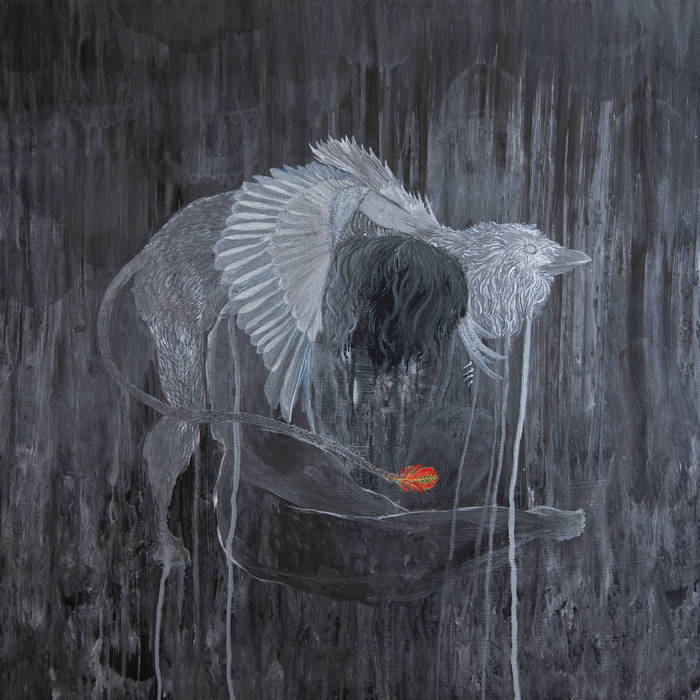
Every Rock, Every Half-Truth Under Reason operates less as a collection of songs and more as a sustained inquiry into a specific form, memory, and resistance to coherence.
Continuing Kayo Dot’s long-standing refusal of genre-stability and repetition, Toby Driver and Co. foreground duration, timbral & tonal density, and negative space over melodic legibility. Then the pieces unfold and construct according to internality, often resulting in opaque and soporific cohesion. The album adheres to accumulation and erosion rather than development, allowing textures to solidify fracture, and dissipate without conventional resolution. In doing so, it positions the listening experience as an act of endurance and interpretation, where finding meaning of it all is provisional and the affect you gather from it emerges not through catharsis, but through an exposure of prolonged tension that structurally puts you in a state of ambiguity and unease - this album is a commanding one to endure, but the reward is very worth much the patience. The disorientation starts off with “Mental Shed”. Their opening piece here is driven by blurred, unsettling sonic textures and tones. First thing I notice, as this track is layering with ambience and drones, is that Toby and company are deviating away from predictability, and really trying to emphatically dig up some hauntology and viscerality in their songcraft. The second track, “Oracle By Severed Head”, which was released as a single, really ebbs and flows into something melodic without sounding accessible in a conventional sense. It begins with a kind of Post-Rock formula before jumping into this chaotic, angular Free-Jazz, chamber-sounding frenzy. >”Closet Door in the Room Where She Died”, the third track, is a 14-minute piece that is equal parts intense and anxiety-induced. This song burns slowly with resistance that doesn’t show any signs of letting up. This track has absolutely no percussive elements as it unveils itself through long, drawn-out drones and microtonal textures. From there we dip into the next track, “Automatic Writing”. Clocking in at 23 minutes, this is the longest track on the record and is strikingly different from the other pieces off the album. It is packed with ambient, drone-ladden instrumentals, where in the midst of these immersive and hypnotic sounds, it is quite easy for the listener to get lost in the sonic landscapes that Kayo Dot seducingly engulf you in. You have these horns weaving in and out that really hit you with melancholy and dreamlike introspection. This track is, by far, the most thoughtprovoking and contemplative of the entire album. The final track, “Blind Creature of Slime”, functions as a negative space within the record: a reminder of what lurks beneath language, structure, and belief. Rather than horror in a dramatic sense, the track evokes discomfort through intimacy as the track is built in this slow, adhering pace. You’re placed inside the creature’s amorphous mind — confined, slow, unable to orient yourself. It’s not something that scares you because it’s violent, but because it’s inescapable as the song feels like it is thickening, thinning, and stiffening as the the creature is changing shape throughout the track.
With eleven releases in and spanning over two decades worth of music, it clearly shows that Kayo Dot aren’t fatigued with banality or even grasping at straws to come up with new ideas and vagaries. Every Rock, Every Half-Truth Under Reason ultimately leaves the listener in a collection sounds that, by the end of the final track, puts you in a memory of tension, of having discovered something vast, formidable, and indifferent to comfort. In that sense, this album demands attention and rewards devotion, and reassures Kayo Dot’s ability to make inaccessibility feel, not only purposefully embracing, but also necessary.