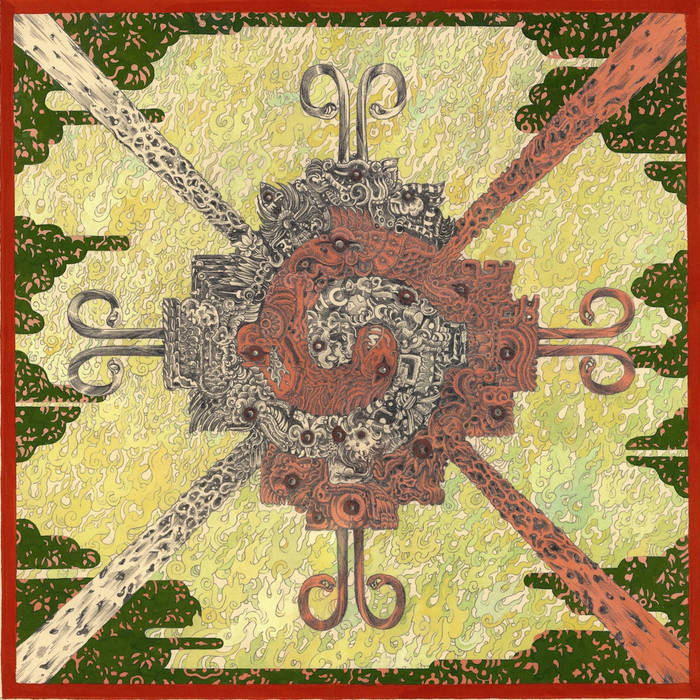
One cannot but admire musicians like Patrick Shiroishi. Folks who go all in with their music, their profession and confession, who strive for spots unknown to them, galaxies far far away where no man has gone before. Enter Shiroishi‘s (*) Zeuhl-project Corima which has been dormant for a decade. Now they’re off again to new frontiers again, with Hunab Ku!
Zeuhl – a style of music rooted in the oeuvre of French Prog-Rock pioneers Magma. Their drummer Christian Vander (who was trained in the classical ways) and singer Klaus Blasquiz invented this style of music in the late 60s as a free form of flowing music taking influences from Jazz legend John Coltrane but also from genres as divers as Folk, Prog, Blues or (Neo-)Classical composers like Strawinsky or Orff. The latter’s love for polyphonic harmonies is one of the most clearly audible elements of Zeuhl. Whether Zeuhl bands also use Magma’s invented language Kobaïan for their songs or not is not a necessity but surely a kind of homage and traditionalism. That can also be said about Corima, who use the language of the fictitious planet of Kobaïa, the outer space refuge of mankind, and stick to many of the ideas and ideals of Zeuhl but who also try to develop it further.
Even when they do so, for example by incorporating some rich Punk outbreaks, one might ask to what extent one can really develop a genre whose very ideas and foundations it was to think outside the box and do things no band had done before. (One might go so far, that this music is as much Math-Core in the Dillinger Escape Plan-sense as it is Jazz in the Coltrane mindset as well as Classical in the string quartet idea) Anything goes.
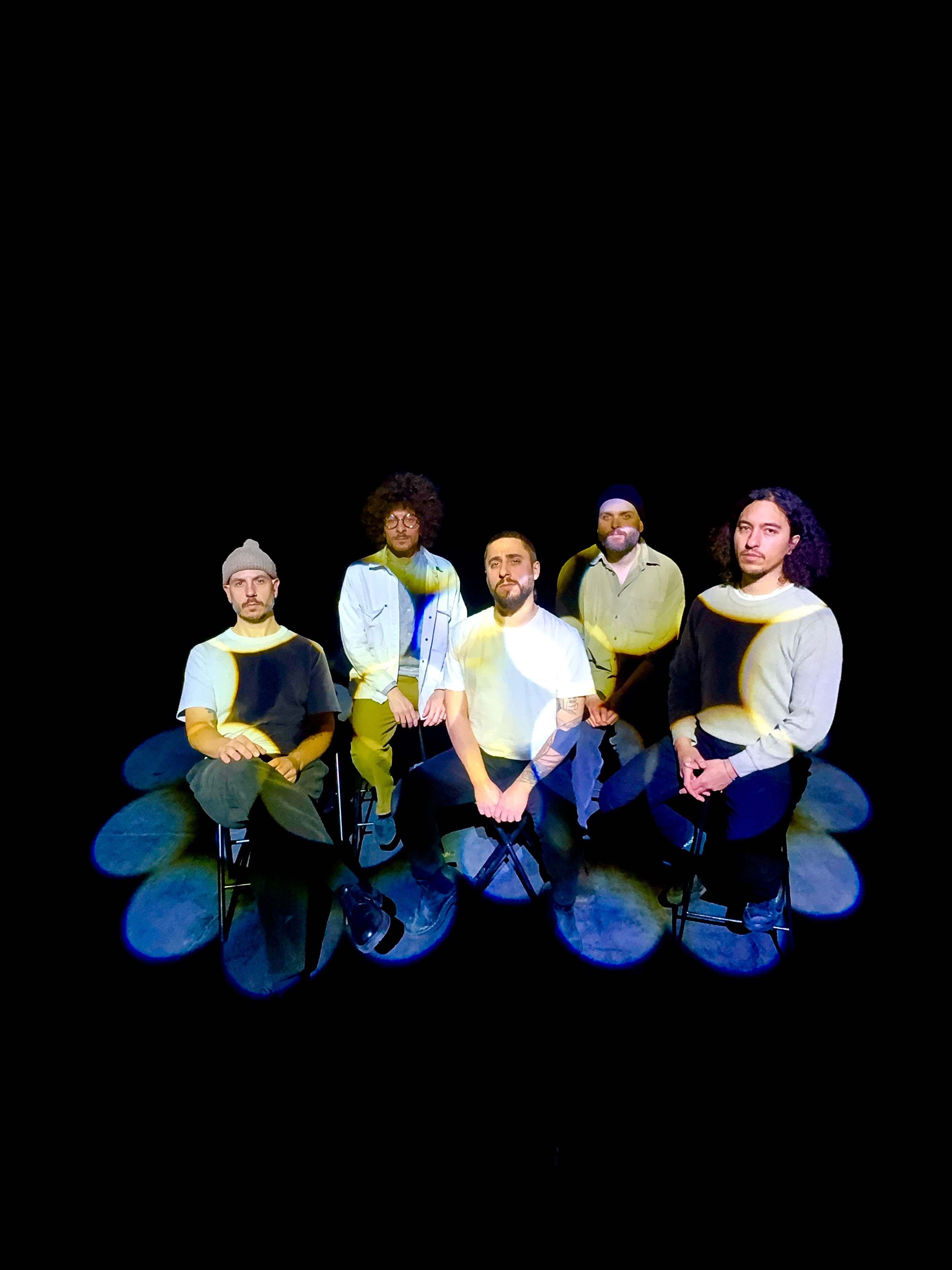
With Corima we witness a form of Zeuhl that surely is two things – and I quote my daughter - “bright” and “orderly chaos”. The music has so many fun elements like the wonderfully silly gibberish utterances in ”Manla”, the warmth provided by the organ or the French-infused glockenspiel parts in ”Ho-Huitzilopochtli-Tlaloc” (please, don’t ask me to pronounce it!) - there is a certain kind of juvenile playfulness coming from musicians who surely know what they are doing. Corima is five musicians bringing eleven kinds of instruments to the table (not counting the various singular instruments, because Patrick surely brought along more than one saxophone) and all of these get their spot to shine. The fact that four of the band members also speak for the polyphonic notion which would make the Mamas and the Papas proud. By the way, is bass player Ryan so bad at singing that he is not allowed to do so? Just joking! Because that should be noted – the bass is the driving force behind Corima’s music (as with many Zeuhl bands) as it has to hold everything tight and thriving. The drums are less of a rhythmic element but more another part of the “ordered chaos”. Even on a real Punk track like the final one, ”Kultunlilni” the drums go berserk and Ryan has to keep all the guys in stock. One might be forced to press replay over and over again to catch all the single, highly imaginative tidbits in these songs, but that is exactly what it seems to be all about – the songs are great examples of how one needs many spins. Take the opener ”Yok’hah” - starts in the thick of the thin, with some vocal passages, some ebb and flow (nearly call-and-response-like) rhythmic passages but who notices the thick carpet of synths and (probably) violin underneath it all from the first moment for what it is? And when that foundation also seems to rise after the first and second breaks the track becomes lighter and brighter and all of that with some minute details for the listener. These passages are probably also reason why it took Corima ten years to come up with new music – the devil’s in the details, right?
To me, Corima also works wonderfully on another level – in a time when the world that seems decided that it’s bound to love its mind – we have a five-piece from Los Angeles, all of them with a migrational background it seems, playing music that is very French, releasing their record on a traditional French label dedicated to this music which was invented by musicians with their own migrational background (Slavic and Basque). How more cosmopolitan and less national can it get?
Hunab Ku is radiantly happy, wonderfully childish, composed by experienced and highly skilled musicians and should be a joy to all of you! A lot of love goes out to Corima and all the people who live their lives for “the music” (and the spouses who let them do so. Thanks!)
(*) When going through the article again and talking to Patrick I want to point out one thing: Corima is not “Patrick’s” band, he is not the band leader, but a member. I just wanted to showcase how diverse his complete body of work is, as a member of the Armed, a great solo artist and cherished contributor. However, Corima is not his band, he is only one of the five amazing musicians behind the band, the whole project needs each and everyone of these great people!